
Introduction
The New Manufacturing Paradigm in Biologics Biopharmaceutical manufacturing is undergoing a structural transformation. Increasing product diversity, the rise of personalized therapies, and accelerated regulatory pathways are forcing manufacturers to rethink how facilities are designed and operated.
Traditional stainless-steel facilities—built around large, fixed infrastructure—often require 5–7 years from design to commercial operation. In contrast, modern biologics pipelines demand speed, flexibility, and rapid scalability.
This shift has fuelled the rise of modular biomanufacturing, where facilities are designed as prefabricated, scalable production units built around single-use technologies (SUT). These facilities enable biopharmaceutical companies and CDMOs to deploy manufacturing capacity in significantly shorter timelines while maintaining regulatory compliance and operational efficiency.
The increasing adoption of modular platforms is closely tied to the expansion of single-use technologies, where disposable bioprocess components replace permanent stainless-steel equipment.
As industry demand grows for fast-track biologics production, modular infrastructure combined with disposable process systems is emerging as the new standard.
What Is Modular Biomanufacturing?
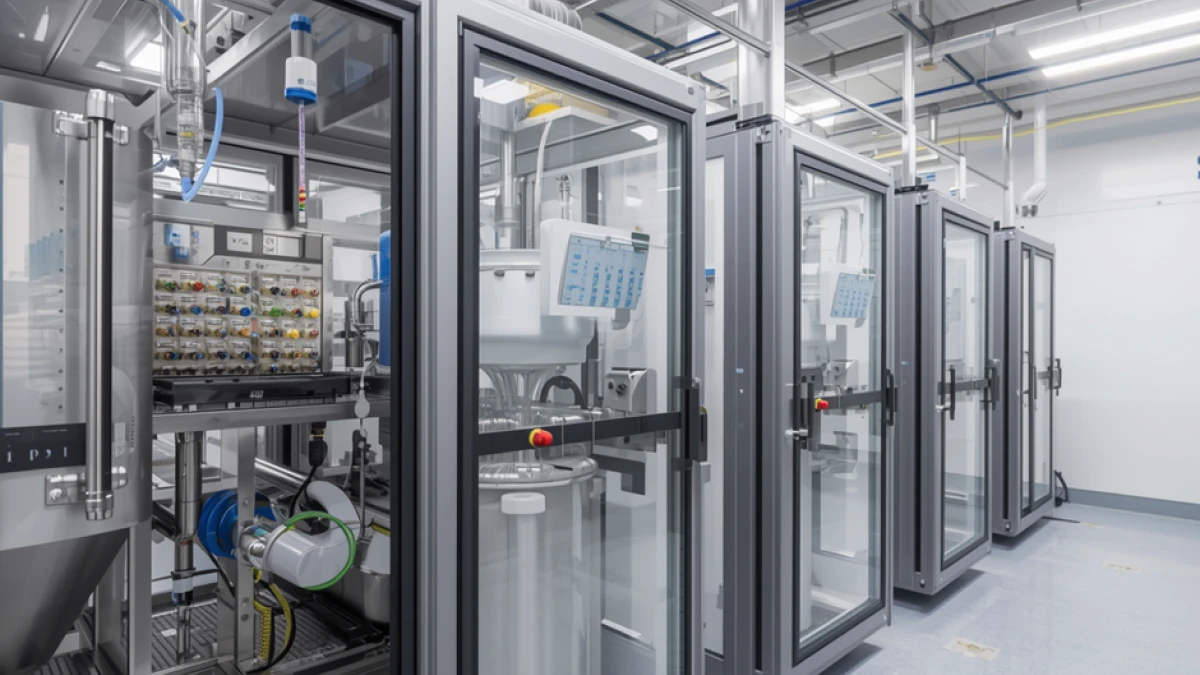
Modular biomanufacturing refers to the design and deployment of prefabricated, self-contained manufacturing units that can be assembled, expanded, or reconfigured depending on production needs.
Instead of building large integrated plants, manufacturers create process modules such as:
• Upstream cell culture suites
• Media and buffer preparation units
• Downstream purification modules
• Fill-finish production areas
These modules are often manufactured off-site and later installed within a facility shell or containerized environment.
Key Characteristics of Modular Facilities
Feature | Description
Prefabricated Infrastructure | Process modules constructed off-site to reduce construction time
Scalable Production Units | Additional modules can be added as capacity grows
Single-Use Process Integration | Disposable systems reduce facility complexity
Rapid Deployment | Facilities can become operational in 12–24 months
By integrating single-use systems, modular plants eliminate many of the utilities required for stainless-steel operations, including clean-in-place (CIP) and steam-in-place (SIP) infrastructure.
Why Modular Biomanufacturing Is Driving Single-Use Adoption
- Reduced Capital Investment
Traditional biologics facilities require extensive infrastructure, including:
• Clean steam systems
• Large water-for-injection (WFI) plants
• Complex piping networks
• Cleaning validation equipment
Modular facilities built around single-use technologies significantly reduce these requirements.
Key cost advantages include:
• Lower utility installation costs
• Reduced facility footprint
• Minimal cleaning infrastructure
• Faster facility qualification
For emerging biotech companies and CDMOs, this approach allows capital investment to shift from infrastructure toward process development and pipeline expansion.
- Faster Time-to-Market for Biologics
In the competitive biologics landscape, speed is often the decisive factor between commercial success and missed market opportunity.
Modular facilities designed around disposable technologies offer significant advantages:
Manufacturing Approach | Typical Facility Deployment
Stainless Steel Facility | 5–7 years
Hybrid Facility | 3–5 years
Modular Single-Use Facility | 12–24 months
Eliminating CIP/SIP systems and permanent piping significantly accelerates:
• Facility design
• Equipment installation
• Qualification and validation
For fast-track biologics, including vaccines, monoclonal antibodies, and gene therapies, modular plants enable companies to move rapidly from clinical scale to commercial production.
Process Integration in Modular Biomanufacturing
One of the key enablers of modular biomanufacturing is the integration of single-use process components across both upstream and downstream workflows. Custom single-use assemblies and fluid management systems play a critical role in enabling efficient and contamination-controlled modular manufacturing environments.
Upstream Process Integration
Modular upstream production suites commonly utilize:
• Single-use bioreactors
• Single-use mixing systems
• Media preparation systems
• Closed fluid transfer assemblies
Benefits include:
• Reduced contamination risk
• Simplified batch changeovers
• Lower validation requirements
• Improved process containment
Single-use bioreactors allow flexible scaling from development scale to 2,000 L production scale without significant facility redesign.
Downstream Process Integration
Downstream purification modules increasingly rely on disposable flow paths and buffer management systems.
Key single-use components include:
• Holding bags for buffer storage
• Pre-sterilized tubing assemblies
• Disposable filtration systems
• Single-use mixing systems
These systems simplify buffer preparation and product transfer while reducing cross-contamination risks between manufacturing campaigns.
Flexible Manufacturing for Multi-Product Facilities
Modern biologics facilities rarely produce a single product.
CDMOs and large biotech companies increasingly operate multi-product manufacturing environments where several biologics may be produced within the same facility.
This introduces operational challenges:
• Product changeover downtime
• Contamination control requirements
• Cleaning validation complexity
Flexible manufacturing enabled by disposable process systems addresses these challenges.
Advantages of Flexible Modular Production
• Rapid changeover between production campaigns
• Minimal cleaning validation
• Reduced cross-contamination risk
• Improved facility utilization
In modular facilities, individual process suites can be dedicated to specific products or easily reconfigured depending on production needs.
This flexibility is especially valuable for:
• Biosimilars manufacturing
• Clinical trial production
• Personalized medicine
• Contract manufacturing operations
Infrastructure Efficiency in Single-Use Modular Plants
One of the most significant advantages of single-use technologies in modular environments is infrastructure simplification.
Infrastructure Component | Stainless Steel Facility | Single-Use Modular Facility
Clean Steam System | Required | Not required
CIP/SIP Systems | Required | Eliminated
Large WFI Storage | Required | Reduced
Process Piping | Extensive | Minimal
Facility Footprint | Large | Compact
Reduced infrastructure complexity allows modular plants to operate with smaller facility footprints while maintaining production capacity.
Implementation Considerations for Modular Biomanufacturing
Although modular manufacturing offers clear advantages, successful implementation requires careful planning.
Key Factors to Consider
- Supply Chain Reliability
Single-use systems depend on reliable sourcing of:
• Disposable bags
• Tubing assemblies
• Filtration components
• Connectors and fittings
Manufacturers must implement dual-sourcing strategies and robust vendor qualification programs to ensure uninterrupted operations.
- Extractables and Leachables (E&L) Assessment
Regulatory agencies expect comprehensive evaluation of materials used in disposable systems.
Manufacturers must ensure:
• Documented E&L studies
• Compatibility with process fluids
• Validated sterilization methods
Proper material selection is critical for maintaining product safety and regulatory compliance.
- Standardization of Process Modules
To fully leverage modular infrastructure, facilities must adopt standardized process designs.
Standardization allows:
• Faster installation of additional modules
• Easier process replication across sites
• Simplified regulatory documentation
Regulatory Considerations for Modular Single-Use Facilities
Regulatory agencies such as the FDA and EMA increasingly recognize the advantages of modular production environments.
However, facilities must demonstrate:
• GMP compliance across all modules
• Validated sterile barriers in disposable assemblies
• Appropriate environmental controls
• Traceability of materials and components
Because modular plants often rely on pre-sterilized assemblies, suppliers must provide:
• Certificates of irradiation
• Sterility assurance data
• Complete quality documentation
Strong supplier partnerships are therefore essential for regulatory readiness.
Future Outlook
The Next Generation of Modular Biomanufacturing
The future of biologics manufacturing will likely be defined by increasingly flexible production platforms.
Several emerging trends are shaping the next phase of modular biomanufacturing:
- Fully Disposable Bioprocess Facilities
Facilities where nearly all process equipment—including bioreactors, mixers, and fluid paths—is disposable.
- Digital Integration and Smart Manufacturing
Integration of sensors and automation into disposable systems will enable:
• Real-time process monitoring
• Predictive process control
• Advanced data analytics
- Global Distributed Manufacturing
Modular plants allow companies to deploy smaller regional production facilities, improving supply chain resilience.
This model is particularly important for:
• Vaccine manufacturing
• Personalized medicine
• Regional biologics supply
FAQ
Modular Biomanufacturing and Single-Use Facilities
What is modular biomanufacturing?
Modular biomanufacturing refers to prefabricated, scalable production facilities composed of independent manufacturing modules that can be rapidly deployed or expanded.
Why are single-use technologies important in modular facilities?
Single-use technologies eliminate complex cleaning infrastructure and piping systems, allowing modular facilities to operate with reduced utilities and faster installation timelines.
How do modular facilities reduce time-to-market?
Because modules are prefabricated and rely on disposable process systems, facility construction and validation timelines are significantly shorter.
Are modular facilities suitable for commercial-scale production?
Yes. Many modular facilities now support 2,000 L single-use bioreactors and commercial-scale downstream processing.
Do regulatory agencies accept modular manufacturing?
Yes. Regulatory bodies accept modular designs provided facilities meet GMP standards and maintain robust quality documentation.
Conclusion
Modular Infrastructure Is Redefining Biopharmaceutical Manufacturing
The growing complexity of biologics pipelines is pushing the industry beyond traditional manufacturing models. Modular biomanufacturing provides a scalable and flexible approach that aligns with the realities of modern drug development.
By integrating single-use technologies, manufacturers can reduce capital investment, accelerate facility deployment, and respond more effectively to evolving production demands.
For CDMOs and biopharma companies operating in a competitive global market, modular manufacturing represents a shift toward more agile biologics production.
As biologics pipelines expand and therapies become increasingly personalized, the convergence of modular infrastructure and single-use technologies will continue to shape the future of biomanufacturing.